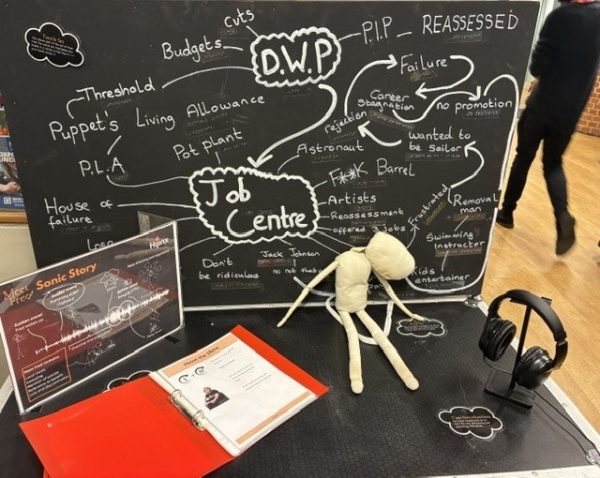
Meet Fred is a puppet show created by Hijinx Theatre. It aptly stars a puppet named Fred, who for all his synthetic body parts is every bit human in where it matters – to gain true societal acceptance is to do one thing: get a job. It is a deviously simple task for anyone but especially for those with learning disabilities, which is what Meet Fred aims to tackle with its unique satirical commentary, combining wit and realist themes of disillusionment and despair in our system.
Fred has found success all across the globe and we were honored to have him back for his 10th anniversary! This blog post, written by Claire Frampton of our Theatre Club, goes into detail about her encounter with the world-famous puppet up close…
Hijinx is an award-winning theatre company and registered charity from Wales which pride themselves on the involvement of autistic individuals and/or people with learning disabilities in every creative process. It aims to challenge perceptions, to uplift and to give voices through artistic expression.
Review of Meet Fred by Claire Frampton
On entering the theatre to watch Meet Fred, the stage set had a black background, like a blackboard, decorated with a spider gram type diagram with writing and drawing in what seemed like white chalk. This appeared to demonstrate the brainstorming process, giving insight into the development of ideas for the show; the presentation of information on stage in this way was one of the unique aspects of this production. The subtopics within cloudlike shapes were locations, or scene names such as Children’s Party, Job Centre, Rock Bottom etc. This was a clever way of giving the audience a taster of what they might see in the play, it also introduced the dynamic of a “work in progress” type atmosphere – as well as the background diagram, the play showcased various perspectives not usually seen on stage. As the play began, a guy stood up from a seat in the front row, wrote on the blackboard, introduced himself as the director and took a photograph of the audience with a phone – this established informality, and gave a sense of acknowledgement of the audience. Within the performance, the director crossed off scene titles in the spider gram. At the end of the show, not all of these were crossed off, suggesting that only some generated ideas were fulfilled. This made me imagine how the unfulfilled scenes would have worked out. I always find it fascinating when the process of a play, exhibition etc. is part of the presentation.
Text in surtitles above the stage described details in the action, also the script. This was part of the accessibility of the play, and the play itself dealt with issues including inclusivity and ability. I felt the surtitles were important – they were an aid to understanding of the action, which had unconventional aspects.
Fred, the main character of the show was a doll-like puppet with a unique dynamic on stage – operated by three puppeteers who were part of the performance and held parts of his body, rather than a puppet operated with strings. The puppeteers were all visible, vital to Fred’s movement – Fred is presented as highly supported. The puppet itself didn’t have a face – just a head as a blank canvas and a male puppeteer spoke the Fred’s lines and made facial expressions – demonstrating a range of emotions not usually possible with more conventional puppets. This did confuse the puppeteer as character/performer, and the puppet was almost more of a prop – though it was a focus. In part of the show, Fred attended appointments at the job centre regarding a job search. There was a scene where he attempted the role of children’s party entertainer – an amusing aspect was dancing to Michael Jackson. There was an element of audience interaction where Fred stood on an audience member’s knees and had a cuddle, this was a compassionate element. After a variety of fun scenes, including a date, the storyline became poignant when, after failing to secure a job, one of the puppeteers is removed, and Fred loses use of one of his legs. The use of his leg is restored however Fred is assisted to climb up a tall building (represented by a ladder onstage) with the aim of committing suicide and does end up jumping off and moves slowly through the air. This seemed to reflect similar real-life stories and issues in today’s society, relating to job seeking, ability etc. It seems unclear whether this is the “end” for Fred since this is also the end of the play; though the play is a comedy, the ending is sombre/unclear.