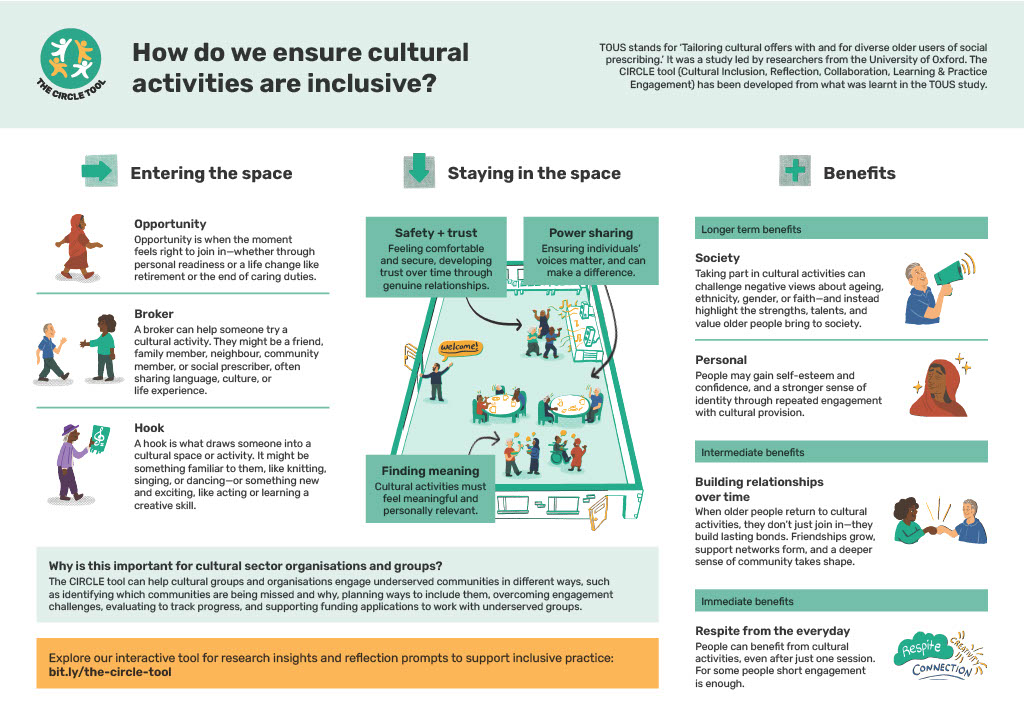
On 18 March the Storytelling team spoke at the launch of the CIRCLE Tool, a free-to-access online resource designed to support cultural organisations to think about accessibility and inclusion for older people with Global Majority backgrounds.
The CIRCLE Tool was developed by researchers at the Centre for Evidence-Based Medicine, University of Oxford as part of the TOUS Study (Tailoring cultural offers with and for diverse older users of social prescribing). This study looked at the health and wellbeing effects of cultural activities for people over 65 from Global Majority communities, using a range of approaches including the Storytelling Evaluation Method (Storytelling). The OFS Storytelling team trained the TOUS researchers in Storytelling and supported evaluations of three cultural organisations around the country – an arts centre, a theatre, and a women’s centre – with existing, successful programmes for this cohort The stories collected from these sites, and the insights generated by our discussions of them, informed the content of the CIRCLE Tool, as well as the wider findings of the study, which you can read about in this journal article.
Our work with the TOUS Study team has contributed significantly to the development of Storytelling over the past couple of years. It’s helped us to understand how our approach fits within a wider context of qualitative academic research and presented opportunities to think more deeply about inclusion and accessibility in the method itself. We’ve had lots of interesting conversations with the TOUS researchers and with the storytellers on the project about how to edit the stories of people who speak English as an additional language, and how to make participation in our discussion sessions easier for older people.
Debra Westlake, one of the TOUS researchers, had this to say about using Storytelling:
“Storytelling allowed people to share experiences in their own words, at their own pace, and in ways that reflected how they naturally make sense of their lives. It enabled richer, more relational accounts than formal interviews, helping participants feel heard and respected while capturing cultural, emotional, and contextual detail. Connections, such as how structural inequalities and discrimination shape engagement with cultural spaces, unfolded naturally in the stories, where they are often lost in more formal interviews.
Storytelling gave me permission to relax and enjoy connecting with storytellers and the opportunity to hear their story in the way they wanted to tell it, rather than imposing my questions. OFS provided practical guidance and also created space for reflection, shared interpretation, and problem-solving, strengthening both the quality of the stories and the learning drawn from them. It is an approach we will use again.”
You can find out more about Storytelling at our website, www.storytellingevaluation.co.uk
This article was written by Will Long, Storytelling Manager at the Old Fire Station.
About Storytelling:
The Storytelling Evaluation Method (Storytelling) is a qualitative learning and evaluation approach inspired by Most Significant Change. It involves collecting stories from people about their participation in a project and then bringing other people together to analyse these stories collectively. Storytelling amplifies the voices of those closest to the work, supports meaningful collaboration, and produces nuanced insights. It is an enjoyable process that aims to be non-reductive, non-extractive, inclusive, and empowering – both illustrating and reinforcing the benefits of person-centred practice.
Storytelling is especially suitable for learning about the impact of holistic, relationship-based, and context-specific work that is difficult to evaluate using quantitative measures alone. It helps organisations to recognise unexpected outcomes and to understand how change happens. The Old Fire Station has now trained over 250 local and national partners in using this method, including other cultural organisations, local authorities, charities, voluntary and community groups, and university researchers. If you want to speak to the OFS Storytelling team about training or consultancy support, you can get in touch here https://www.storytellingevaluation.co.uk/contact